
Click tracks are not fun at all to play along with at the start. They are horribly frustrating. They mercilessly point out any mistakes in your timing, and they won’t even give you a second of mercy if your fingers get stuck while navigating a tricky chord change.

Choosing to ignore it, however, is the very reason your timing seems just a little bit off when trying to play with a drummer.
There’s no need to even leave the house for the music shop to spend forty dollars on an oversized plastic machine. No, really – it only takes opening a free online metronome in a new tab to solve this issue. Choose a tempo, press the spacebar, and endure the clicks until you get it right.
If you are still coming up with excuses not to use one, this is why you have to stop.
1. It Kills the Unconscious Rush
Whenever you practice alone, you speed up. There’s no way around it. A riff sounds cool, you get pumped up, and pretty soon, you’re playing at ten beats per minute faster than where you started. And then you get to the bridge, which is the difficult bit, and you slow down. The really funny thing is that you don’t even realize you’re doing it.
The click track doesn’t lie. It makes you pay attention to that space between the notes. Pretty soon, that ticking noise is permanently etched in your mind.
2. The Ultimate Ego Check
Playing a solo and then instantly ripping it at full speed is an old newbie error. Of course it does not sound good, does it? You are basically teaching yourself bad habits through muscle memory.
Slow down! Really, cut the tempo in half. Practice it so slowly that it becomes boring. Once it is perfect, increase the click by two or three beats.
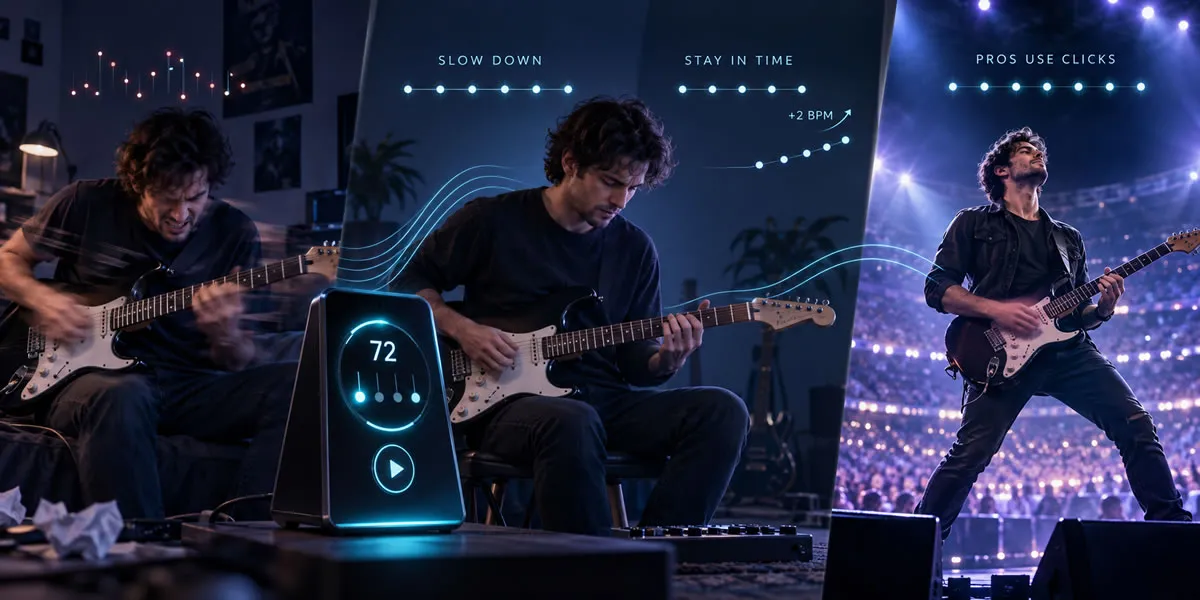
The Stadium Reality (Yes, Your Idols Use It)
There is this crazy belief that click tracks are some kind of training wheels for middle school band rehearsal. Attend any stadium concert. Everyone who is on stage there has got a blaring click track inside their ear monitors.
Let's take Ed Sheeran. He creates those huge loops live on stage when performing Shape of You. Any tap of his foot slightly off time would make the entire loop worthless. Charlie Puth adds fifty vocal tracks to his song Attention - none of it can happen without mathematical exactness. Even Muse’s drummer gets his click track drilled into his brain while performing Uprising so that the fireworks go off right. It’s not a crutch. It’s what the pros really do.
3. Fast Playing Is Just Accurate Playing
Everyone wants to play fast. But sloppy speed is entirely useless.
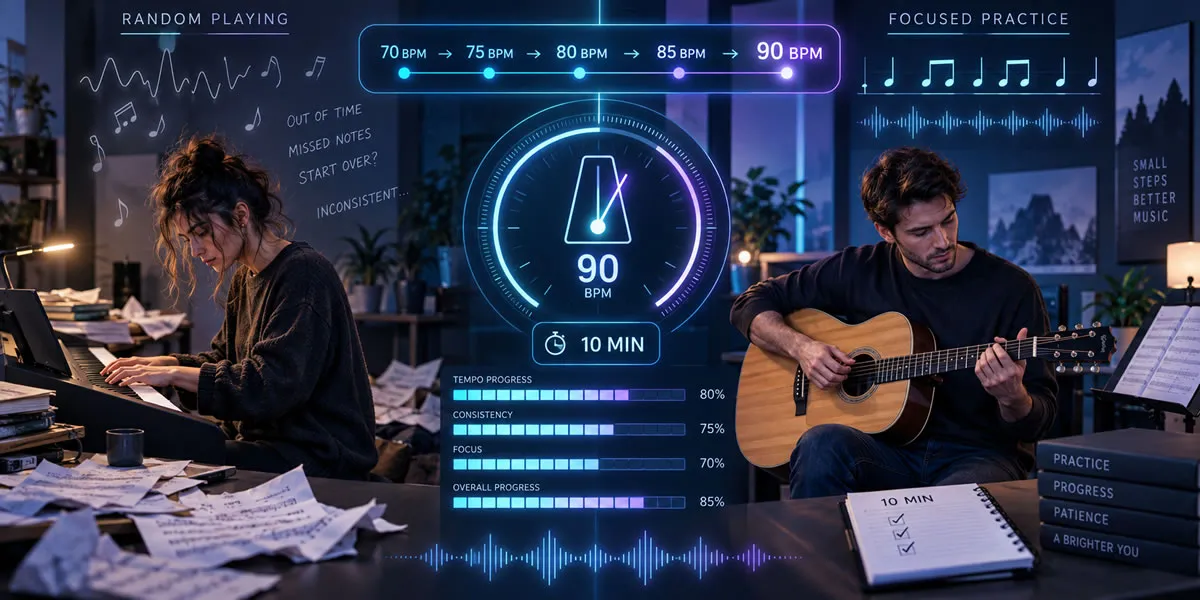
For those practicing their scales on the piano or trying to work through a complicated vocal run, the click will help develop their speed safely. Begin with a tempo of 70 BPM. Move the tempo slider only once the phrase is played perfectly – no buzzing strings, no hesitations, and no forgotten breaths. Go for 75. Speed does not have any magical powers; it’s nothing but slow practice gradually increasing in speed.
4. It Stops You From Just “Noodling”
Sitting on your bed and playing the same three songs you already know for twenty minutes isn’t practicing.
Using a tempo gives you actual data to track. Monday you practice a riff at 80 BPM. By Wednesday, you push it to 85. By Friday, 90 BPM actually feels comfortable. And if you only have 15 minutes before you have to leave the house? Two minutes of warming up to a slow click and ten minutes of drilling a specific measure does more for your skills than an hour of random, unfocused playing.
5. There Is Zero Setup Time
Mechanical metronomes are certainly aesthetically pleasing. They look fantastic sitting atop your piano. Yet, you'll forget to take it to your lessons, or the batteries in your digital one will run out.
A browser-based clicker is merely something that exists. Waiting for your Zoom lesson? Open up the clicker. Hanging out in your living room with your acoustic guitar? Pull out your phone. In the absence of any friction when it comes to beginning your practice routine, you stand a far better chance of following through.
Don't think of the metronome as punishment. It is the greatest free musical mentor you'll ever have. Just work on your technique with it for ten minutes a day, and I promise you that your bandmates will be noticing.
Final Thoughts
A metronome on the internet is an easy-to-use device that has a huge effect. It will allow one to develop proper timing, make the complex parts easier to play, enhance one's technique, provide structure, and offer a convenient means of practicing. The key to getting the most out of the metronome is the regular use of it.