A choir could shadow you for a week, and you would not be able to quote the second verse. This is not difficult to explain. It is precisely how listening happens. You get hooked by the melody. The lyrics come afterwards, or do not come at all, or maybe many years after the fact, since someone stupidly tied an afternoon to it.
In March 2026, a little group of 50 French people — native speakers — heard excerpts from Boris Vian; they did not have them in their possession beforehand. They processed the words of the music better than the words of the lyrics. In addition, 234 people had already disputed the texts, so the stimuli were not nonsense. The music was there before the lyric. The lyric still distorted the picture; it just came too late.
That lateness is not the same thing as weakness. The two layers do not walk in at the same speed.
On some occasions they even work against one another. A collection of 172 listeners, from age 7 to age 20, received popular excerpts in which the mood of the melody and the mood of the wording either agreed or failed to agree. When the pair was in conflict, the older participants more often took the emotion from the melody. The younger ones were more ready to follow happy or sad lyrics. Fear did not follow the same pattern. The result is not a rigid rule. Age only affects which part is noticed first. That tension also helps explain the role of lyrics in creating a powerful song.
Meaning is also able to arrive when no lyric is present at all.
In a well-known N400 experiment, people heard either a spoken sentence or a piece of instrumental music and then looked at a target word. Words that did not belong produced a larger N400 after both sorts of prime. Music can prepare a concept, in a manner similar to language. This does not prove that the work is completed before a person becomes aware of it. Sung words merely add a second pipe. If the line cannot be made out, it does not enter the account.
Memory is the place where a song ceases to be common property.
In 2025, 84 persons heard clips of popular songs and recovered an autobiographical scene on 49 percent of the trials. The same lines, spoken by a flat computer voice, did this in 33 percent. Familiarity did not remove the gap. The impression that the song felt heavier mostly went away after familiarity was placed into the calculation. A recording from a graduation, or from a breakup, or from a car at an ugly hour, is therefore no longer only a verse. It is a date that has learned to hum.
Attention is less attractive and just as important.
Lyrics take up room when the song is not the only occupation. A 2023 study with college students — the numbers sat between 113 and 123, according to the task — found that background music with words reduced verbal memory, visual memory, and reading comprehension by a small or moderate amount. Instrumental lo-fi did not clearly repair the work and did not clearly damage it. That division of focus is now ordinary, and it is also considered in our look at music and lyrics that increase concentration. Someone may check scores, pregame prices, or live markets in the MelBet apk while a playlist runs. In that situation, he still registers the rhythm and the colour of the voice. He does not register every line. Keeping any betting spend inside a fixed bankroll also gives the mobile session a limit, instead of permitting a live market to become the only task in the room.
Repetition does quieter labour than mood does.
It teaches the order of the words. Students at the University of Colorado who already knew the nine-line “CU Fight Song” rebuilt the lyric with more accuracy than persons hearing it for the first time. They also kept certain lines because of the seat those lines occupied in the sequence. This may be the reason a familiar refrain can appear almost unavoidable. One phrase starts, and the next is already waiting near the door. After a sufficient number of plays, the language stops being language. It turns into a path.
The room can then push the words nearly out of sight.
With headphones, the same recording can resemble a story. In a crowded hall it shrinks into pulse. A football broadcast may treat the track as a long ascent, with a chant performing the work that a drop would perform on a record. An adult following a match and live odds on MelBet may receive the song first as part of the atmosphere and only later, on a quieter replay, notice what the singer said. The file has not been altered. The listening job has.
If a rough examination is wanted, no laboratory is required.
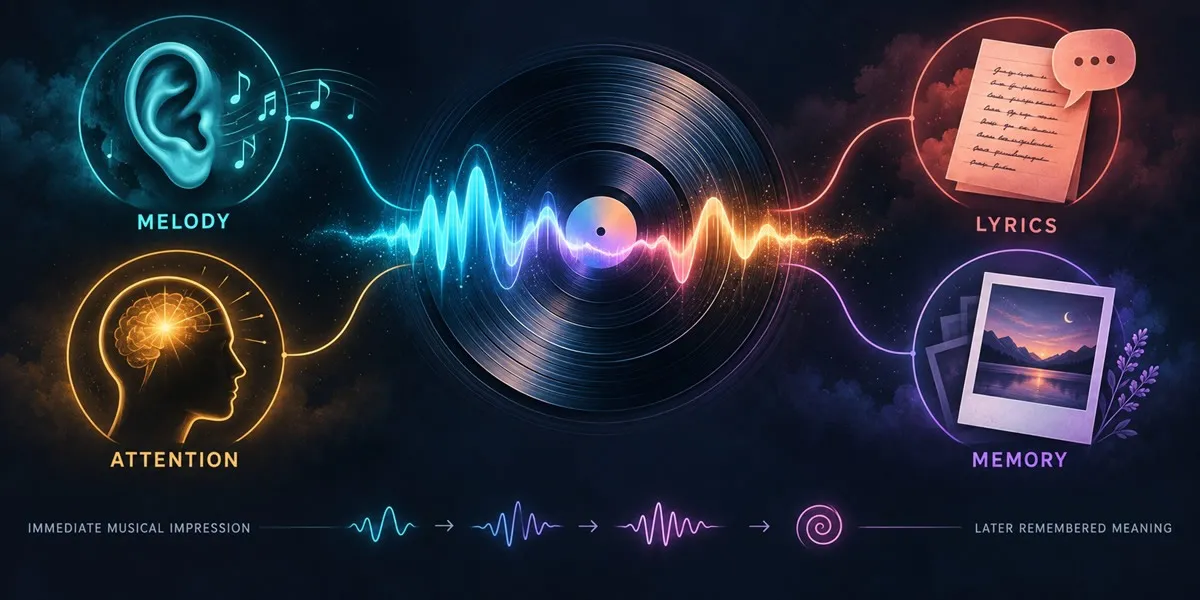
Play the piece once and do not look at a sheet. Read the licensed lyrics, then compare the experience with a guide to reading lyrics more carefully. Play it again with the text in front of you. Observe whether the narrator moves, or the mood, or the line a person would actually send to somebody else. The 2026 session with Vian, using excerpts that were still fairly unfamiliar, indicated that musical meaning can become available sooner than lyrical meaning. Work on autobiographical memory adds the other portion: once the song belongs to the listener, familiarity begins to select what remains. One recording can therefore survive several hearings, because melody, wording, old associations, and whatever else was happening at the time do not strike with equal force.
Those listeners between 7 and 20 were not disordered because the design was careless. They were disordered because a song is on several channels at the same moment, and nobody keeps only one of them switched on.