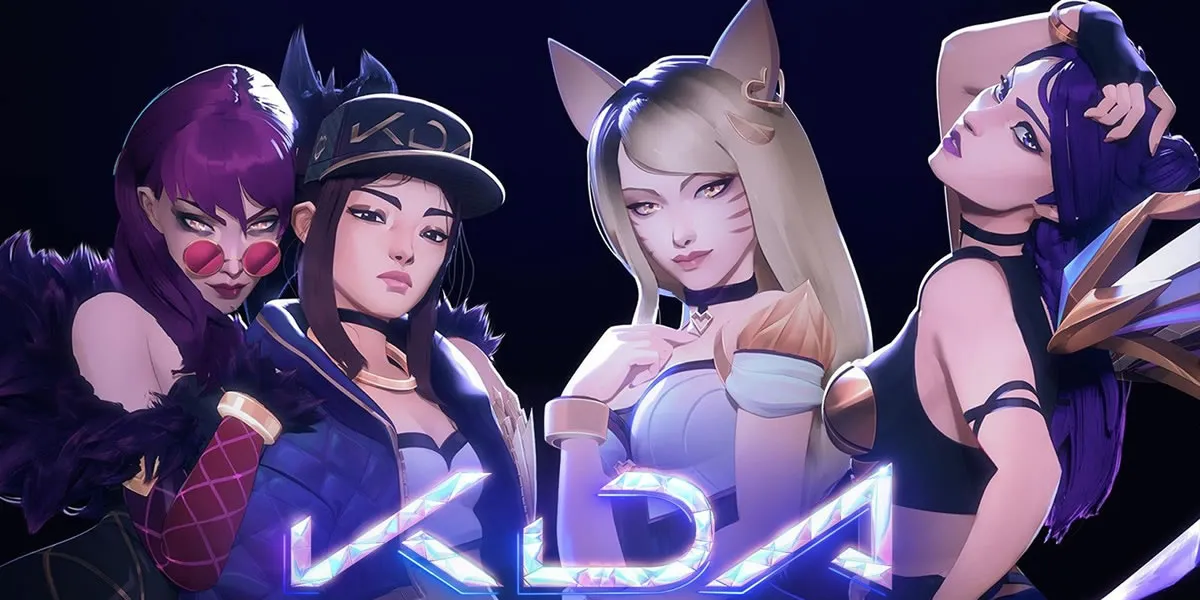
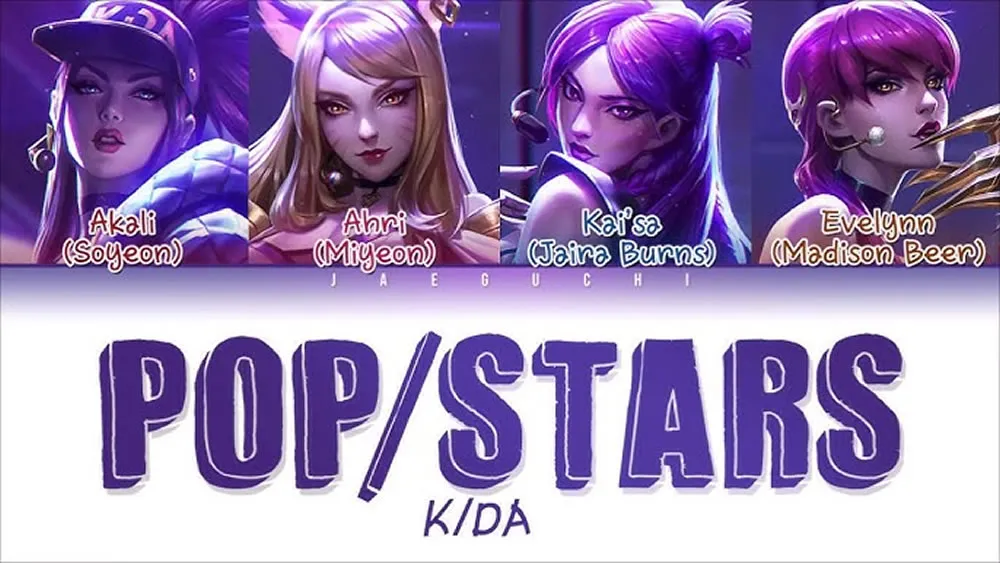
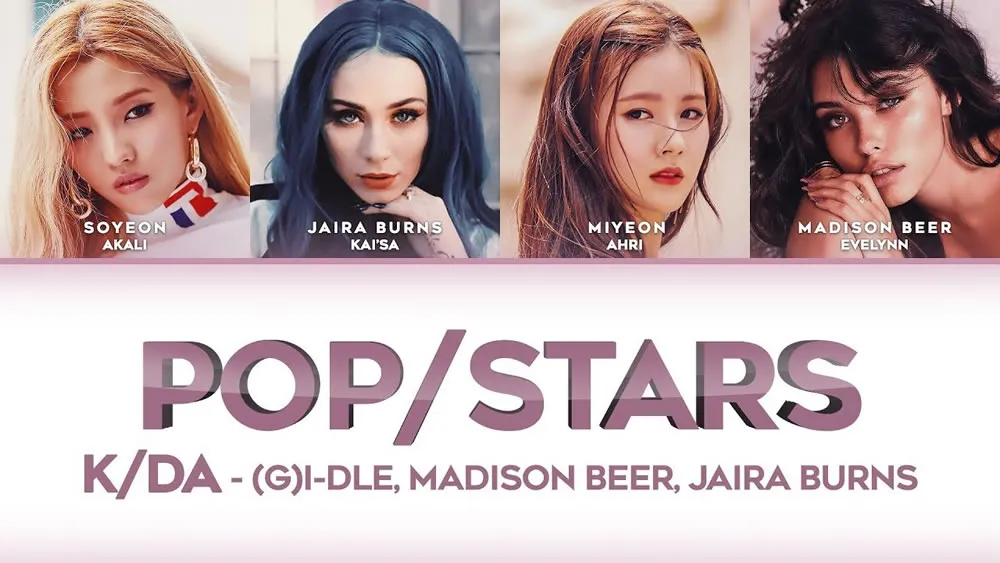
The concept behind K/DA was deceptively simple. Riot took four existing champions: Ahri, Akali, Evelynn, and Kai'Sa: and gave them a parallel identity as a pop group. The vocal performances came from a carefully chosen mix of real-world talent: Miyeon and Soyeon of (G)I-DLE voiced Ahri and Akali respectively, while American artists Madison Beer and Jaira Burns brought Evelynn and Kai'Sa to life. On stage at Worlds, the four human performers shared the spotlight with augmented reality versions of their K/DA alter egos: rendered life-size and impossibly polished. The audience's reaction made it clear that Riot had accidentally invented something.
The Numbers That Broke the Internet
"POP/STARS" did not quietly chart in a gaming niche. It went straight to number one on Billboard's World Digital Song Sales chart: sitting above EXO and BTS in the same week: and debuted at number ten on the Pop Digital Song Sales chart. The music video crossed 100 million YouTube views within a month. According to Riot's own figures, the track accumulated over 170 million DSP streams and the video eventually surpassed 340 million views, making it the most successful debut for a K-pop group in YouTube history at the time.
What made those numbers extraordinary was the context. K/DA had no prior discography, no fan meetings, no album cycle, and no physical members who could do talk show appearances. The group existed only where pixels and bandwidth would take them: and that turned out to be more than enough.
Key Chart Achievements of "POP/STARS" (2018)
● Reached number one on Billboard's World Digital Song Sales chart in its debut week.
● Debuted at number ten on Pop Digital Song Sales and number thirty on the overall Digital Song Sales chart.
● Hit number five on Apple Music's pop chart in the United States.
● Became the most-viewed debut music video for any K-pop act in YouTube history at the time of release.
The Formula: Lore as a Marketing Engine
The secret ingredient was not just the song: it was the characters behind it. League of Legends had spent years building out the personalities, backstories, and visual identities of its champions. Players already had strong feelings about Ahri, Akali, Evelynn, and Kai'Sa long before K/DA existed. Riot did not introduce new characters and ask people to care; they took beloved ones and gave them an unexpected dimension. A fan who had played Akali for three hundred hours was emotionally primed to listen to her rap verse. That pre-existing attachment is not something a conventional label can manufacture overnight.
Riot had precedent for music: their virtual metal band Pentakill had been around since 2011: but K/DA operated on an entirely different scale of ambition and execution. The lead developer behind the project later described the team's approach as immersing themselves completely in K-pop: watching music videos, studying production trends, and working with industry professionals to get the sound right. The result was a track that was authentically K-pop in structure and feel, not a parody of it.
K/DA: From Debut to ALL OUT
| Release | Year | Notable Collaborators | Chart Peak |
| "POP/STARS" | 2018 | Madison Beer, (G)I-DLE, Jaira Burns | #1 Billboard World Digital |
| "THE BADDEST" | 2020 | (G)I-DLE, Bea Miller, Wolftyla | #1 Billboard World Digital |
| "MORE" | 2020 | Madison Beer, (G)I-DLE, Lexie Liu, Jaira Burns, Seraphine | #1 iTunes K-Pop / #7 iTunes US |
| ALL OUT EP | 2020 | TWICE, Kim Petras, Aluna, Bekuh BOOM, Annika Wells | Multiple global chart entries |
ALL OUT: Proving It Was Not a One-Hit Trick
Two years of silence after "POP/STARS" could have killed K/DA. Instead, the fanbase kept the group alive through art, cosplay, and cover videos: a kind of parasocial loyalty that genuine pop stars spend careers trying to cultivate. When Riot returned in 2020 with "THE BADDEST" and the ALL OUT EP, the audience was already there and waiting.
ALL OUT expanded both the sonic palette and the roster. The five-track EP brought in TWICE, Kim Petras, Lexie Liu, Aluna, and the virtual champion Seraphine: who had her own parallel story arc playing out simultaneously inside League of Legends as a new playable character. Both "THE BADDEST" and "MORE" reached number one on Billboard's World Digital Song Sales chart. Riot had moved from proving the concept to building an actual music catalogue.
ALL OUT EP: Tracklist and Featured Artists
● "THE BADDEST": featuring (G)I-DLE, Bea Miller, and Wolftyla, released as a pre-EP single in August 2020.
● "MORE": the lead single featuring Madison Beer, (G)I-DLE, Lexie Liu, Jaira Burns, and new virtual member Seraphine.
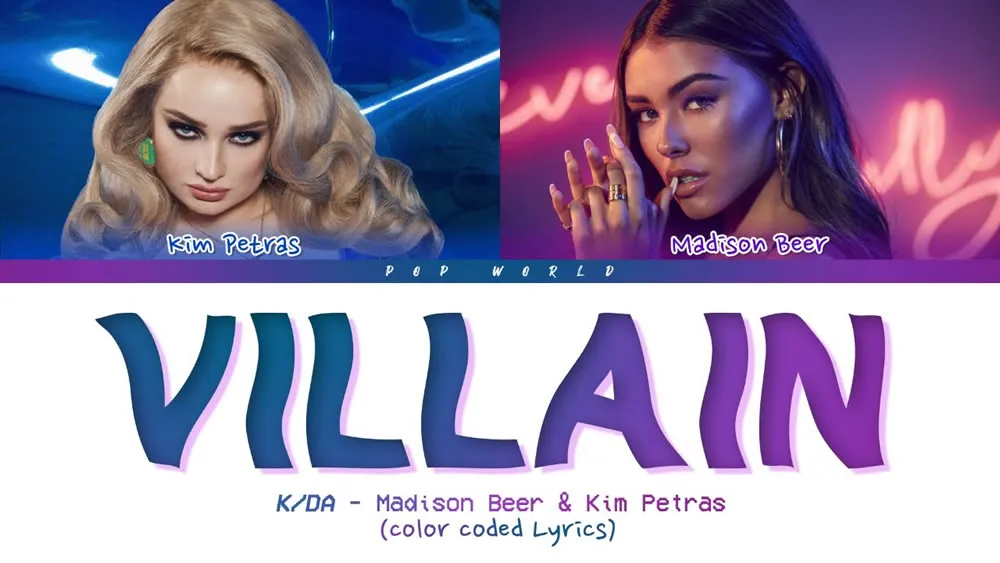
● "VILLAIN": a darker, atmospheric track featuring Madison Beer and Kim Petras.
● "I'LL SHOW YOU": marking TWICE's first-ever collaboration with a Riot Games project, alongside Bekuh BOOM and Annika Wells.
● "DRUM GO DUM": a percussion-heavy closer featuring Aluna, Wolftyla, and Bekuh BOOM.
The Bigger Picture: What K/DA Actually Changed
Virtual bands are not a new idea. Gorillaz: the animated group formed by Damon Albarn and illustrator Jamie Hewlett: had pioneered the concept in the late 1990s and gone on to sell over 33 million equivalent albums. Hatsune Miku, the Vocaloid software turned global concert phenomenon, proved that a character without a physical body could fill arenas. But K/DA did something neither precedent fully achieved: they proved that a gaming IP could generate genuine mainstream chart success on music platforms, without any physical touring, without any press cycles, and without the artists ever appearing as themselves rather than as their game characters.
The downstream effects have been measurable. Riot has since launched additional virtual acts including True Damage and Heartsteel, and established Riot Games Music as a functioning label operation with distribution, A&R, and promotional infrastructure. Other game studios and entertainment companies have taken note. SM Entertainment's aespa: where each member has a virtual alter ego: launched in 2020 in a model that shares obvious DNA with K/DA's dual-identity approach. The idea that a game character can simultaneously be a pop star, a playable champion, and a cosmetic skin sold for ten dollars has become a legitimate playbook rather than a novelty experiment.
Why K/DA Worked Where Others Had Not
● Riot built on characters that already had millions of invested fans, removing the need to build an audience from scratch.
● The production quality matched: not imitated: the K-pop genre's actual industry standards rather than offering a gamer-friendly approximation.
● The augmented reality live performance at Worlds 2018 gave the concept a physical spectacle that generated immediate viral spread.
● Each comeback was tied to in-game events, creating a feedback loop between music engagement and gameplay investment.
The Lasting Legacy
K/DA did not just make a good song: though they did make a very good song. They demonstrated that the wall between entertainment categories is architectural rather than structural: you can knock it down if you build something compelling enough on both sides. The group's success validated the idea that gaming companies could operate as serious music industry players, not just licensing partners or background score producers.
For the fans who found League of Legends through "POP/STARS," the journey probably felt like discovering a new band. For the players who already knew every ability on Ahri's kit, it felt like their favourite character had been given a new dimension. That double entry point: lore fan and music fan meeting at the same track: is K/DA's real structural innovation, and it is one the music industry is still trying to fully absorb.
Key Takeaways for the Music Industry
● Gaming IPs carry pre-built emotional investment that traditional labels spend years trying to manufacture.
● Augmented reality and in-game integration can replace: or significantly amplify: conventional promotional cycles.
● Virtual artists are not a gimmick category; they are a scalable format that has now produced multiple Billboard number-one singles.
● Cross-genre authenticity matters: K/DA worked because Riot treated K-pop as a craft to master, not a style to borrow.
There were exactly zero tours, zero meet-and-greets, and zero physical albums involved in any of this. The four members of K/DA have never taken a single flight between cities. They do not age, take hiatuses, or deal with contract disputes. Whether that is reassuring or slightly unsettling probably depends on how you feel about the future of the music industry in general: but either way, you already know every word to "POP/STARS."